
01
Place One Queen in Every Row, Column, and Region
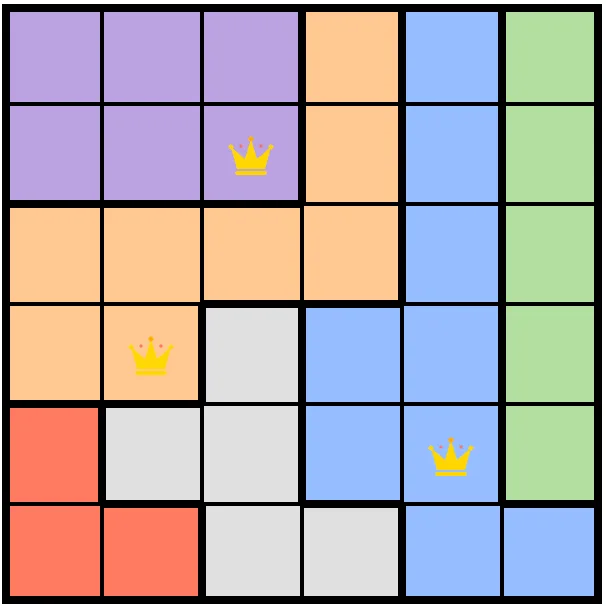
Core placementEach puzzle needs exactly one queen in every row, every column, and every color region.
Solve 3 core puzzles to complete today's Quick Set. Then unlock 2 optional Bonus puzzles.

Play Queens Game and more logic puzzles anytime without limits.
Play free Queens puzzles directly in your browser. Complete the homepage Quick Set, practice unlimited board sizes, or return for the shared Daily Challenge—no download or account is required to start.
Today's Quick Set starts with three progressively larger core puzzles and then unlocks two optional bonus challenges. Begin with a compact 5×5 board or 6×6 board, complete the core set on 7×7 or 8×8, and continue into larger 9×9 or 10×10 bonus boards when you want a deeper challenge. Finishing the first three always counts as completing the core Quick Set.
Quick Set is different from the Daily Challenge. The Daily Challenge is the single shared board of the day, while Quick Set is the homepage starter path: faster to enter, easier to sample, and a natural bridge into the full Queens puzzle library.
Queens Game is a region-based logic puzzle that combines the row-and-column restrictions of the classic N-Queens problem with colored regions and a no-touch rule. Your goal is to place exactly one queen in every row, every column, and every colored region. No two queens may touch, including diagonally, so each placement removes options from several parts of the board at once.
The rule set is also similar to a one-star Star Battle puzzle, but Queens uses crowns and a clear one-queen-per-region goal. On QueensGame.io you can begin with the five-puzzle homepage Quick Set, play the shared Daily Challenge, or explore a library of 2,500 standard and community Queens puzzles. Boards range from 4×4 to 12×12, giving new players a compact place to learn and experienced solvers room for longer deductions.
See the core rules fast, understand the move cycle, and jump straight into the board.
Each puzzle needs exactly one queen in every row, every column, and every color region.
Tap or click once to place a queen, a second time to add an X marker, and a third time to clear the square. Use X marks to record eliminated cells instead of holding every restriction in your head.
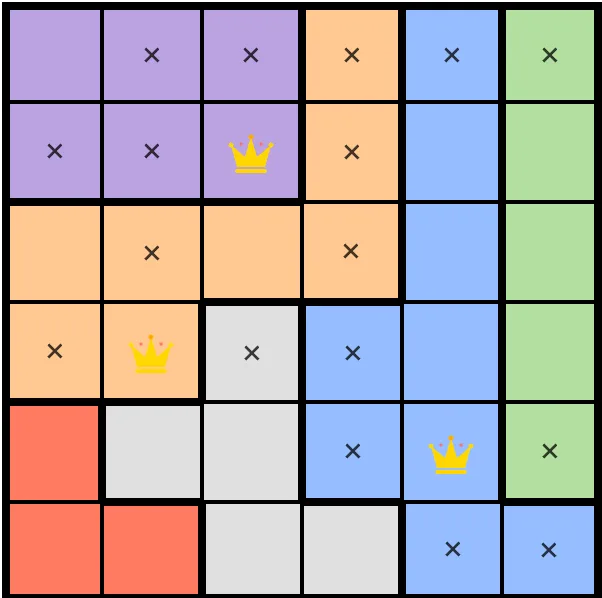
Queens cannot touch, even diagonally. Satisfy every row, column, and region to solve the puzzle.
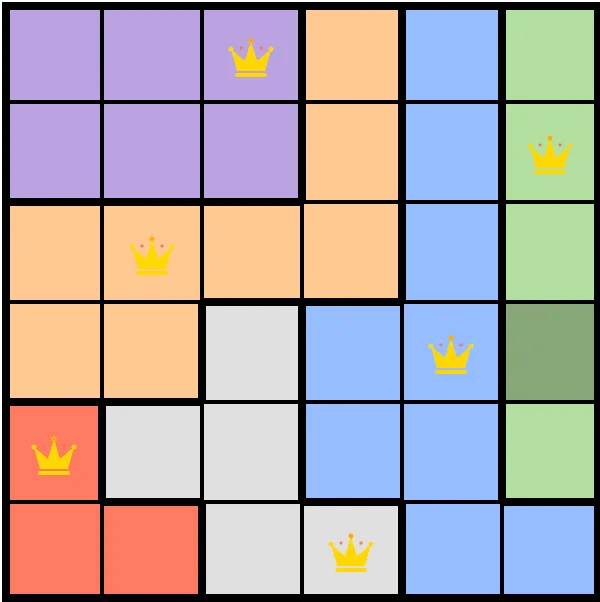
Grid size controls how much of the board you need to scan, but it does not determine difficulty by itself. Standard puzzles have separate Easy, Medium, Hard, or Expert ratings based on their actual layouts, so use board size to choose your pace and the recorded difficulty to choose the depth of reasoning you want.
Compact boards are quicker to scan and make the row, column, region, and no-touch rules easier to observe. Start with 4×4, 5×5, or 6×6 when you are learning the move cycle, testing a new technique, or fitting in a short warm-up.
Boards from 7×7 through 9×9 create more overlapping restrictions without becoming difficult to read at a glance. They are a strong everyday range for practicing systematic X marks, spotting forced placements, and preparing for the shared Daily Challenge.
Larger 10×10, 11×11, and 12×12 boards require broader scanning and more careful tracking of eliminated cells. Choose them when you want a longer session, then use the Easy, Medium, Hard, and Expert filters in the standard level library to select the actual challenge level.
Combine careful elimination with deliberate practice. The strongest routine helps you find forced moves on the current board, then repeat the exact grid sizes and difficulty levels that still slow you down.
Scan for a row, column, or color region with the fewest open squares. Compare its remaining cells against every existing queen. When only one valid square survives all four rules, you have found a forced placement without guessing.
Add X marks to squares ruled out by an existing queen, a completed row or column, a completed color region, or the no-touch rule. Visible eliminations reduce repeated scanning and make new single-option rows and regions easier to notice.
If one board size consistently takes longer, open that dedicated size page instead of jumping randomly between puzzles. Repeating similar dimensions helps you recognize recurring region shapes, track longer elimination chains, and measure whether your scanning is becoming more efficient.
Use the three core Quick Set levels to establish a solving rhythm, then continue into the two optional Bonus boards when you want more practice. Move to the Daily Challenge once your eyes are already tuned to rows, columns, regions, and diagonal contact.
After you learn the core rules, pick the format that fits best: today's board, the full archive, community puzzles, or the leaderboard race.
Play the shared puzzle of the day, compare your solve, and come back tomorrow for the next board.
Browse thousands of Queens puzzle boards by grid size and keep solving without daily limits.
Explore creative community puzzles and see how other players stretch the rules in new ways.
See who is solving fastest, track the pace at the top, and turn each board into a score chase.
Clear answers about Quick Set difficulty, Daily Challenge stats, unlimited play, grid sizes, puzzle solutions, and mobile access.